Best Faceless YouTube Channel Niches That Make Money (2026)
You've probably spent hours scrolling through channels, trying to figure out which faceless niche might actually work. Maybe you've bookmarked a dozen "top 10 faceless niches" articles, watched countless YouTube tutorials, and somehow ended up more confused than when you started.
Most faceless niche advice treats YouTube like a list of topics you can hide from. But YouTube doesn't pay you for avoiding the camera. It pays you for solving problems people actually search for, keeping their attention, and doing it in a format you can replicate without burning out.
This guide works differently. Instead of another recycled listicle, we're showing you exactly how to find, validate, and dominate faceless niches using TubeLab's data-driven niche research platform. TubeLab scans hundreds of millions of YouTube videos daily to surface breakout channels, outlier videos, and emerging niches, with filters for monetization potential, faceless feasibility, and content quality.
What you're getting:
Most creators misunderstand this: a niche is what your channel is about. "Faceless" is just how you produce the content.
That distinction matters because typical faceless niche guides secretly answer the question "What topics let you avoid filming yourself?" But YouTube doesn't reward you for hiding. It rewards you for:
So you should be asking:
 Split comparison diagram showing wrong vs right way to think about faceless YouTube niches: faceless as format choice, not topic filter
This is a production-meets-market question. It forces you to think about demand, feasibility, and sustainability, not just how to avoid the camera.
This guide gives you both parts: a map of faceless-friendly archetypes (format machines) and a system to discover and validate niches (market validation) using TubeLab's niche research tools.
If you want a faceless channel that survives, you need to understand the platform climate right now. Honestly, it's gotten stricter.
YouTube's monetization policies explicitly target "inauthentic content" and "reused content". The platform clarified (including in recent policy updates) that repetitive or reused content without meaningful original value can lose monetization eligibility.
What this means: If your faceless channel is built on templated scripts, recycled stock footage, and zero originality, you're building on sand.
In late 2025, reporting suggested a significant portion of YouTube recommendations to new users were low-quality AI-generated content. Whether you love or hate the term "AI slop," the market impact is clear: the supply of low-effort faceless content exploded, and YouTube responded.
In February 2026, reports indicated that YouTube was actively removing or wiping videos from multiple large "AI slop" channels. Treat this as a signal: the risk profile for faceless channels has changed.
In January 2026, YouTube announced changes to how it monetizes content around sensitive topics (with mass shootings cited as an example). If your faceless niche relies on shock, tragedy, or sensationalism, your revenue stability is at risk.
YouTube now requires disclosure for certain synthetic or altered content. Using AI for script help or idea generation is fine, but creating realistic synthetic scenes or altered reality requires following their disclosure workflow.
The good news: In February 2026, YouTube announced expanded auto-dubbing with 27 languages supported and more than 6 million daily viewers watching at least 10 minutes of auto-dubbed content.
This changes the game for faceless creators:
For faceless formats (where your face isn't a localization barrier), this is huge.
What it means: The 2026 faceless opportunity is real, but it requires quality, originality, and strategic thinking. Copy-paste content farms are done.
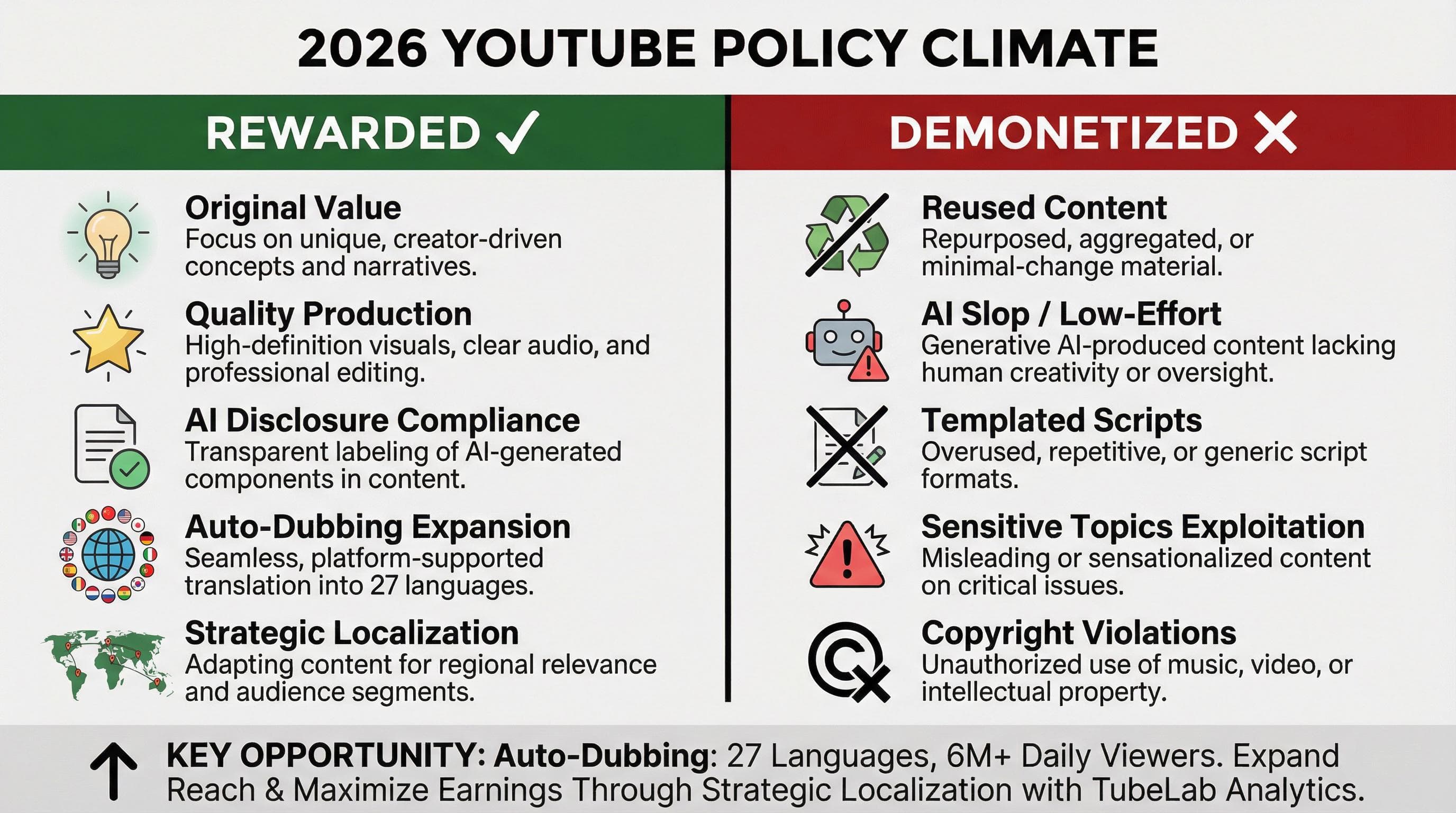 Split comparison showing YouTube's 2026 policy enforcement: rewarded vs demonetized faceless content categories
Before we get into specific niches, you need to understand how TubeLab frames YouTube niche research. It's brutally simple and incredibly useful.
TubeLab's model treats YouTube as an attention market:
A niche is basically a mini-market. Your job is to find markets where:
① Demand is real (people are watching)
② Supply is low or weak (not many creators or most are low-quality)
③ Your format is replicable (especially critical for faceless)
TubeLab's guides describe niches as moving through lifecycle stages:
Stage | Description | Best Action |
|---|---|---|
Whitespace | Almost no creators, some demand starting | Enter now (best time) |
Breakeven | More creators arrive; supply ≈ demand | Compete on quality |
Saturation | Supply > demand; only top-tier survives | Avoid or differentiate |
Most "top 10 faceless niches" lists point you toward established markets, which are already saturated. The real opportunity is finding rising or hidden niches early, which is exactly what TubeLab's rising niches guide teaches you to do.
 YouTube niche demand vs supply matrix showing five market zones: whitespace, rising, breakeven, saturation, and hidden markets with lifecycle progression
TubeLab's niche philosophy talks about "hidden markets" where viewers don't know they want the content until they see it. These can look weird on paper but explode in practice. TubeLab even cites examples like "AI Wild Animal Rescues" as hidden market concepts.
This is why data matters. You can't spot hidden markets with gut instinct alone. You need tools that show you what's actually working now, not what worked in 2021.
Most creators pick niches based on vibes. That's a recipe for wasted months. Better approach: score every niche candidate on 7 dimensions (0 to 10 each).
Copy this into Notion, Sheets, or wherever you plan. Then actually use it.
Are people already watching this content at scale? Are there multiple channels with recent breakouts?
Validation: Use TubeLab's Niche Analyzer to check market size and saturation.
How many channels are competing in the same format? Are thumbnails and titles all converging (a saturation smell)?
Validation: TubeLab's Niche Finder shows how many breakout channels exist in a topic area.
Are there many "1 of 10" outlier videos (videos that massively outperform a channel's average) in this niche recently? Are smaller channels producing outliers (signal of accessible growth)?
Validation: TubeLab's Outliers Finder filters videos by z-score and average views ratio to surface true outliers.
Does this topic attract high-intent advertisers, buyers, or sponsors? Can you monetize outside ads (affiliate, products, courses)?
Validation: TubeLab supports filtering by RPM estimates in its channels and outliers datasets.
Can you produce high-quality visuals without filming yourself? Are there reliable asset sources (screen recordings, animation, original graphics, licensed footage)?
Validation: TubeLab tags channels and videos by "faceless potential" via the classificationIsFaceless filter in the API.
Does the niche push you toward reused clips, celebrity footage, sports highlights, movie scenes? Is it a sensitive topic category?
Validation: Read YouTube's monetization policies and consider whether your format requires third-party IP.
Can you make 50 videos without hating your life? Can you build a repeatable pipeline (scripts, visuals, editing)?
Validation: Honesty check. If the format burns you out after 5 videos, it's not scalable.
A strong faceless niche scores:
If a niche scores below 5 on any dimension, dig deeper or move on.
Most faceless channels fall into one of these format archetypes. Your "niche" becomes a combination of:
Think of this map like a workshop. Pick the machine (archetype), choose your material (topic), and design your product (angle).
Best for: Software, tools, tutorials, fixes
Why it works: Viewer intent is explicit (they're trying to solve a problem)
Example: "How to automate invoices in Excel for freelancers"
Production: Screen recording + voiceover + simple graphics
Monetization: Courses, templates, sponsors, affiliates
Best for: History, science, geography, business concepts
Why it works: You turn complexity into clarity with visuals
Example: "Why Norway is shaped like that" or "How McDonald's supply chain actually works"
Production: Maps, charts, animations, stock footage with narration
Monetization: Decent RPM, sponsorships from education brands
Best for: Mysteries, history, business stories, internet lore
Why it works: Curiosity + retention
Example: "The rise and fall of Vine" or "How Theranos fooled everyone"
Production: Timeline storytelling with diagrams, receipts, original visuals
Monetization: Strong sponsorship potential, good RPM
Best for: Gadgets, apps, AI tools, products
Why it works: Purchase intent drives RPM + affiliate potential
Example: "AI writing tools for marketers: tested and ranked"
Production: Screen demos, side-by-side comparisons, test footage
Monetization: Affiliates, sponsors, high RPM
Best for: Sports strategy, finance simulations, city comparisons
Why it works: Novelty + shareability + repeatability
Example: "What if every NBA team had the same salary cap?" or "Cost of living: NYC vs. Tokyo"
Production: Simulations, data viz, charts with commentary
Monetization: Sponsors, decent RPM, potential for tools/products
Best for: Cooking, DIY, crafts, repairs
Why it works: Tactile clarity; you can film objects, not yourself
Example: "5-ingredient meal prep for busy weeks"
Production: Overhead or close-up shots of hands + materials
Monetization: Affiliates, sponsors, product lines, cookbooks
Best for: Study, sleep, focus
Why it works: Long watch time
Example: "Study with me: 2-hour Pomodoro session"
Production: Minimalist visuals, ambient sound, timers
Monetization: RPM varies; music licensing matters; high reuse risk if low-effort
Best for: Niche-specific updates (AI tools, gaming patches, productivity apps)
Why it works: Recency loops
Example: "This week in AI tools: 5 new launches"
Production: Screen recordings, news aggregation, commentary
Monetization: Sponsors, affiliates; avoid low-value churn and sensitive topics
 Visual reference guide showing 8 faceless YouTube format archetypes with icons and production methods
Pick the archetype that matches your skills and interests, then find a topic where demand exceeds supply.
Each recipe includes: who it's for, best format, monetization stack, TubeLab validation approach, and risk notes.
These niches often have higher advertiser intent, and they also support sponsorships and affiliates. Sponsorship activity on YouTube has been growing strongly, with large year-over-year increases reported in 2025.
Viewer job: Pick the right AI tool for their specific role (e.g., "AI tools for freelance copywriters")
Format engine: Screen demos + before/after workflows
Monetization: Affiliates, sponsors, templates, courses
TubeLab validation: Use Niche Analyzer for "AI tools + [specific role]" then Niche Finder filtered to faceless + recent breakout channels
Risk: Tool hype cycles; you need real testing
Examples: Students, new parents, immigrants, first job
Format: Scenario-based explainers with simple visuals
Monetization: Affiliates (banking, budgeting apps), sponsors
Risk: Don't give personalized financial advice; stay educational
Format: "What it covers / what it doesn't" + real claim stories
Monetization: High sponsor potential
Risk: Accuracy matters; credibility matters
Format: Screen walkthroughs, examples, roleplay scripts
Monetization: Template packs, coaching leads, sponsors
Format: "What it does in 7 minutes"
Monetization: Sponsors, affiliates, lead-gen
Risk: Avoid being a brochure; add real comparisons
Format: Plain-English breakdowns, case structure explainers
Monetization: Sponsors, courses
Risk: Avoid giving legal advice; stick to education
Format: Maps + storytelling
Monetization: Decent RPM; education brand sponsors
Risk: Fact-checking
Format: Documentary narrative + charts
Monetization: Strong sponsorship potential
Risk: Avoid defamation; cite sources
Format: Root-cause storytelling
Risk: Avoid tragedy exploitation; sensitive monetization rules exist
Format: Animated explainers + mission breakdown
Risk: Avoid clickbait "aliens confirmed" spam
Format: Timeline + receipts
Risk: Defamation, harassment; stay clean
Examples: "History of cities," "weird empires," "history of food"
Format: Short documentaries with recurring structure
Format: Screen tutorial + downloadable practice file
Monetization: Course, template packs, sponsors
Validation: Search-based niches benefit from TubeLab's rank checker and rank tracker too
Examples: "Build a portfolio site," "automate invoices," "scrape jobs"
Format: Build-along + repo
Risk: High production effort, but defensible
Examples: "Travel Japanese," "job interview English"
Format: Drills + stories + spaced repetition
Format: Screenshot analysis + principles
Monetization: Sponsors, courses
Format: Animated explainers + real examples
Risk: Avoid generic motivational fluff
Format: Overhead shots + timing + cost breakdown
Monetization: Affiliates, sponsors, cookbook/product
Format: Hands-only demo + parts list
Risk: Safety; clear disclaimers
Format: Tests, comparisons
Monetization: Affiliates + sponsors
Format: Time-lapse + steps
Risk: Saturation if style is generic
Format: Original diagrams + commentary
Risk: Highlights footage is a copyright minefield
Format: Challenge runs, analysis, mods, lore
Monetization: Often lower RPM than finance, but huge demand
Format: Stills you own, abstract visuals, original graphics
Risk: Reused content policy and copyright exposure can wreck you
Risk: Sensitive topics, defamation, low trust, high churn
Examples: Cities, salaries, cost of living, education systems
Format: Charts + narrative
Monetization: Sponsors, affiliates
Examples: "What if..." economics, sports, probability
Format: Simulation + explanation
Risk: Time to build the engine, but once built, it scales
Format: Transparent scoring + sources
Risk: Generic top-10 is weak; methodology is the moat
Format: Long sessions, minimalism
Risk: Hard to differentiate; RPM varies; music licensing matters
Risk: Reuse risk if you use the same loops; low differentiation; monetization can be fragile if content looks mass-produced
 Strategic map of 30 faceless YouTube niches organized by category and monetization potential for 2026
Each of these recipes is a starting point. Your job is to take one, run it through the scorecard, validate it with TubeLab's niche research tools, and execute better than anyone else in that space.
Most people don't need more "niche ideas." They need signals that a niche is actually working. The exact workflow built around TubeLab's core strengths: breakout channel discovery + outlier pattern mining.
Use TubeLab's Niche Analyzer to get a quick read on:
You're not looking for perfection. You're looking to eliminate obvious traps. If a niche shows as "declining" or "fully saturated," move on.
 TubeLab Niche Analyzer tool interface for validating YouTube niche demand and saturation levels
The Niche Analyzer gives you an instant market sanity check. You type in a topic, and it shows you whether the niche is rising, saturated, or declining based on real channel and outlier data.
TubeLab's Niche Finder is built to surface emerging niches by monitoring breakout channels daily.
Filters to start with:
TubeLab explicitly supports filtering by faceless potential and content quality.
 TubeLab Niche Finder interface showing breakout channels filtered by faceless potential and quality metrics
The Niche Finder shows you channels that are punching above their weight. You can filter by monetization status, RPM estimates, faceless potential, and quality to find exactly what you're looking for.
A real niche signal usually looks like:
This aligns with TubeLab's "signal vs. noise" philosophy: don't be fooled by big channels making anything look like a hit.
TubeLab's Outliers Finder gives you a library of outlier videos with filters for:
Your goal: Identify the repeatable video formulas that are producing outliers.
Once you have a cluster of outliers:
TubeLab's Title Formulas tool can help you extract and apply proven title patterns from successful videos.
If your niche is search-driven (tutorials, fixes, how-to), use TubeLab's rank checker to validate whether videos can rank for keywords.
TubeLab's API exposes channel and outlier search with filters including classificationIsFaceless, classificationQuality, RPM estimation ranges, dates, and more.
The research loop for power users:
# 1) Find breakout-ish faceless channels in a topic
curl --location 'https://public-api.tubelab.net/v1/search/channels?query=ai%20tools&classificationIsFaceless=true&classificationQuality=positive&sortBy=viewsMonthly&sortOrder=desc' \
--header 'Authorization: Api-Key YOURAPIKEY'
# 2) Pull recent faceless outliers for that topic (long-form videos)
curl --location 'https://public-api.tubelab.net/v1/search/outliers?query=ai%20tools&classificationIsFaceless=true&classificationQuality=positive&type=video&publishedAtFrom=2025-08-01T00:00:00Z&sortBy=zScore&sortOrder=desc' \
--header 'Authorization: Api-Key YOURAPIKEY'
If you're building a "research flywheel," this is the core loop:
You can automate this entire workflow with TubeLab's API and developer tools.
Get the money mechanics clear, because most creators misunderstand YouTube economics.
YouTube defines RPM (Revenue per mille) as how much you earned per 1,000 views. It can include multiple revenue sources: ads, memberships, Premium revenue, etc.
RPM is what you care about as a creator, not CPM (which is what advertisers pay).
YouTube's partner earnings overview states:
Content Type | Creator Share |
|---|---|
Watch page ads | 55% of net revenues |
Shorts feed ads | 45% of allocated revenue |
That's the backbone. Everything else is variables.
Research based on third-party data reported very wide CPM differences by country, with a global midpoint and large gaps between the US and lower-CPM markets. Use this as directional, not a promise.
What this means for faceless creators:
Because YouTube is expanding dubbing and language support, it becomes more realistic to:
This is especially interesting for faceless formats where the "face" is not a barrier to localization.
 Comprehensive infographic showing YouTube monetization flow for faceless creators: RPM calculation, revenue splits, geographic CPM variations, and auto-dubbing multiplication advantage
 Visual diagram showing YouTube monetization safety zones and danger zones for faceless content creators with 5 key compliance rules
This is where most faceless channels die.
YouTube's monetization policies explicitly describe reused content and inauthentic content as problem categories. If your channel is primarily repackaging others' work with minimal transformation, you're building on sand.
If your videos look like:
...you're drifting toward the exact thing YouTube is targeting.
YouTube's CEO has publicly framed AI as a big bet while also emphasizing responsibility and integrity, which matches the enforcement direction we're seeing. You can read more about TubeLab's history and evolution to understand how the platform has adapted to these changes over 10 years.
If your videos include realistic synthetic scenes or altered reality, use YouTube's disclosure flow and follow the guidance on when disclosure is needed.
If your niche leans into tragedy, violence, or shock, it can get demonetized or restricted more easily. YouTube has updated policies around sensitive events.
 Split comparison showing wrong guesswork approach to niche selection versus TubeLab's data-driven validation method
If you browse "faceless niche" content online, you'll see a lot of:
Most guides publish lists of faceless niches and examples, but usually without a rigorous, data-backed approach to supply/demand, outlier density, or policy risk.
The missing piece is always the same: proof.
What makes a niche real is not that someone wrote it in a blog post. It's that you can see repeatable outlier patterns across multiple channels, with recent performance.
That's exactly why TubeLab exists:
You're not guessing. You're validating. And if you want to understand how TubeLab evolved from a simple rank checker to a comprehensive niche research platform, check out TubeLab's 10-year journey.
A faceless niche isn't really about the topic. It's about the production format. Any niche can be faceless if you can deliver the content effectively without showing your face. That might mean screen recordings (tutorials), voiceover + b-roll (documentaries), hands-only shots (cooking), or animations (explainers). The key is whether the format still communicates value and keeps viewers engaged without your on-camera presence.
Yes, but not by automating low-effort content. YouTube has gotten stricter about reused content and templated output. The faceless channels making money in 2026 are the ones producing original, valuable content in formats that don't require their face. Think high-quality tutorials, data visualizations, documentary storytelling, or skill-building content. The monetization potential is there (ads, sponsors, affiliates, products), but you need to deliver real value.
Use TubeLab's Niche Analyzer to check market size and saturation level. Then look at these signals:
The TubeLab workflow helps you spot rising niches before they saturate by surfacing breakout channels early.
A good faceless niche scores high on the scorecard:
A bad faceless niche usually fails on one or more dimensions: saturated market, low RPM, high copyright risk, or unsustainable production demands.
It depends on how you produce content. YouTube won't demonetize you just for not showing your face. But it will demonetize you for:
Focus on creating original value, following YouTube's disclosure requirements for synthetic content, and staying away from sensitive topics or reused footage.
With TubeLab, you can validate a niche in 1-3 hours:
Manual research without tools? Weeks.
You don't need expensive tools, but data-driven tools save massive amounts of time. TubeLab offers plans starting at $14.90/month (annual) or $29/month (monthly). That's cheaper than wasting weeks in a dead niche. Plus, TubeLab's Niche Analyzer and Rank Checker have free tiers you can use to start validating ideas.
Compare that to the opportunity cost of picking the wrong niche and spending 3 months creating content no one watches. The ROI on research tools is massive.
Yes, but with caveats. AI can help with:
What you can't do: create low-effort, repetitive AI content that looks like every other AI channel. YouTube's CEO has emphasized quality and integrity in the AI era. Use AI as a tool to enhance your production, not as a replacement for original thinking.
Also, follow YouTube's disclosure requirements if you're creating realistic synthetic content.
There's no single "best" niche, but screen-based tutorials are often easiest for beginners:
Pick a tool or skill you already know (Excel, Notion, Photoshop, coding), target a specific use case, and create tutorials solving real problems. Validate demand using TubeLab's Niche Analyzer first.
Follow the TubeLab workflow:
① Market sanity check: Niche Analyzer (is there demand?)
② Breakout channel discovery: Niche Finder with faceless + quality filters (are small channels succeeding?)
③ Pattern validation: Look for 3-10 channels with similar formats and recent outliers (not a one-channel fluke?)
④ Outlier mining: Outliers Finder (what packaging works?)
⑤ Packaging extraction: Analyze top titles and thumbnails (can I replicate this?)
 TubeLab Outliers Finder showing viral video search results with z-score rankings and RPM estimates
The Outliers Finder is where you reverse-engineer winning videos. Filter by topic, recency, z-score, and RPM to find exactly what's working in your niche right now.
If all signals are green, commit to 10 videos. If they're not, pivot early.
It depends on your strategy:
One language (high-CPM market): Build for English-speaking audiences first if you want higher RPM and sponsor opportunities.
Auto-dubbing (volume play): YouTube's expanded auto-dubbing (27 languages, 6M+ daily viewers) lets you build once and expand globally. This works especially well for faceless content where your face isn't a localization barrier.
Hybrid approach: Start in one language, validate the niche, then expand via dubbing once you have a proven format.
RPM varies wildly by niche, geography, and audience:
Niche Category | Expected RPM |
|---|---|
High-RPM (finance, insurance, B2B software, career) | $10-$30+ RPM |
Medium-RPM (tech tutorials, business, productivity) | $5-$15 RPM |
Lower-RPM (gaming, entertainment, ambient) | $1-$5 RPM |
TubeLab filters by RPM estimates in its datasets, so you can see niche-level monetization potential before committing. Geography also matters; US/UK/Canada audiences typically drive higher CPMs than other regions.
Follow these rules:
① Create original visuals (screen recordings, animations, original graphics, your own footage)
② License footage properly (paid stock footage from Storyblocks, Artgrid, etc.)
③ Avoid reusing others' content (YouTube's reused content policy is strict)
④ Don't rely on sports highlights, movie clips, or celebrity footage (copyright landmines)
⑤ Use royalty-free music or license properly (YouTube Audio Library, Epidemic Sound, Artlist)
If your format requires third-party IP, reconsider the niche.
Technically, yes. YouTube allows multiple channels per account. But consider:
Production bandwidth: Can you sustain quality across multiple channels without burning out?
Policy compliance: Each channel needs to follow YouTube's monetization policies
Strategic focus: It's usually better to scale one channel to 100K subs than split effort across three channels at 10K subs each
If you do run multiple channels, use TubeLab's API to automate niche research and idea generation across all channels.
Picking a niche without validation.
Most creators guess based on "what sounds good" or "what's trending." Then they spend months creating content no one watches. The mistake is skipping the research phase.
Use TubeLab to validate:
Data beats guessing every time.
You've got the framework. You've got the recipes. You've got the TubeLab workflow. Now it's time to execute.
What to do next:
Don't commit to one immediately. Pick three that sound interesting based on your skills, interests, and the archetypes above.
Score all three on the 7 dimensions (0-10 each). Be honest. If a niche scores below 5 on any dimension, flag it.
Use the step-by-step workflow:
Once you validate a niche, map out 30 video ideas. Use the title patterns you extracted from outliers. Don't wing it. Plan the content engine.
Commit to 10 videos. Analyze performance with TubeLab's tracker. Iterate on packaging. Double down on what works.
A profitable faceless channel in 2026 is not "automation." It's a repeatable content engine in a market where demand beats supply, executed with enough originality and value that you stay monetized.
You've got the playbook. The niche you pick matters. But the validation process matters more.
Ready to find your faceless niche? Start with TubeLab's Niche Analyzer or sign up for full access to TubeLab's niche research platform to unlock breakout channel discovery, outlier mining, and API automation.
The data is waiting. Go find your niche.
You've probably spent hours scrolling through channels, trying to figure out which faceless niche might actually work. Maybe you've bookmarked a dozen "top 10 faceless niches" articles, watched countless YouTube tutorials, and somehow ended up more confused than when you started.
Most faceless niche advice treats YouTube like a list of topics you can hide from. But YouTube doesn't pay you for avoiding the camera. It pays you for solving problems people actually search for, keeping their attention, and doing it in a format you can replicate without burning out.
This guide works differently. Instead of another recycled listicle, we're showing you exactly how to find, validate, and dominate faceless niches using TubeLab's data-driven niche research platform. TubeLab scans hundreds of millions of YouTube videos daily to surface breakout channels, outlier videos, and emerging niches, with filters for monetization potential, faceless feasibility, and content quality.
What you're getting:
Most creators misunderstand this: a niche is what your channel is about. "Faceless" is just how you produce the content.
That distinction matters because typical faceless niche guides secretly answer the question "What topics let you avoid filming yourself?" But YouTube doesn't reward you for hiding. It rewards you for:
So you should be asking:
Split comparison diagram showing wrong vs right way to think about faceless YouTube niches: faceless as format choice, not topic filterThis is a production-meets-market question. It forces you to think about demand, feasibility, and sustainability, not just how to avoid the camera.
This guide gives you both parts: a map of faceless-friendly archetypes (format machines) and a system to discover and validate niches (market validation) using TubeLab's niche research tools.
If you want a faceless channel that survives, you need to understand the platform climate right now. Honestly, it's gotten stricter.
YouTube's monetization policies explicitly target "inauthentic content" and "reused content". The platform clarified (including in recent policy updates) that repetitive or reused content without meaningful original value can lose monetization eligibility.
What this means: If your faceless channel is built on templated scripts, recycled stock footage, and zero originality, you're building on sand.
In late 2025, reporting suggested a significant portion of YouTube recommendations to new users were low-quality AI-generated content. Whether you love or hate the term "AI slop," the market impact is clear: the supply of low-effort faceless content exploded, and YouTube responded.
In February 2026, reports indicated that YouTube was actively removing or wiping videos from multiple large "AI slop" channels. Treat this as a signal: the risk profile for faceless channels has changed.
In January 2026, YouTube announced changes to how it monetizes content around sensitive topics (with mass shootings cited as an example). If your faceless niche relies on shock, tragedy, or sensationalism, your revenue stability is at risk.
YouTube now requires disclosure for certain synthetic or altered content. Using AI for script help or idea generation is fine, but creating realistic synthetic scenes or altered reality requires following their disclosure workflow.
The good news: In February 2026, YouTube announced expanded auto-dubbing with 27 languages supported and more than 6 million daily viewers watching at least 10 minutes of auto-dubbed content.
This changes the game for faceless creators:
For faceless formats (where your face isn't a localization barrier), this is huge.
What it means: The 2026 faceless opportunity is real, but it requires quality, originality, and strategic thinking. Copy-paste content farms are done.
Split comparison showing YouTube's 2026 policy enforcement: rewarded vs demonetized faceless content categoriesBefore we get into specific niches, you need to understand how TubeLab frames YouTube niche research. It's brutally simple and incredibly useful.
TubeLab's model treats YouTube as an attention market:
A niche is basically a mini-market. Your job is to find markets where:
① Demand is real (people are watching)
② Supply is low or weak (not many creators or most are low-quality)
③ Your format is replicable (especially critical for faceless)
TubeLab's guides describe niches as moving through lifecycle stages:
Stage | Description | Best Action |
|---|---|---|
Whitespace | Almost no creators, some demand starting | Enter now (best time) |
Breakeven | More creators arrive; supply ≈ demand | Compete on quality |
Saturation | Supply > demand; only top-tier survives | Avoid or differentiate |
Most "top 10 faceless niches" lists point you toward established markets, which are already saturated. The real opportunity is finding rising or hidden niches early, which is exactly what TubeLab's rising niches guide teaches you to do.
YouTube niche demand vs supply matrix showing five market zones: whitespace, rising, breakeven, saturation, and hidden markets with lifecycle progressionTubeLab's niche philosophy talks about "hidden markets" where viewers don't know they want the content until they see it. These can look weird on paper but explode in practice. TubeLab even cites examples like "AI Wild Animal Rescues" as hidden market concepts.
This is why data matters. You can't spot hidden markets with gut instinct alone. You need tools that show you what's actually working now, not what worked in 2021.
Most creators pick niches based on vibes. That's a recipe for wasted months. Better approach: score every niche candidate on 7 dimensions (0 to 10 each).
Copy this into Notion, Sheets, or wherever you plan. Then actually use it.
Are people already watching this content at scale? Are there multiple channels with recent breakouts?
Validation: Use TubeLab's Niche Analyzer to check market size and saturation.
How many channels are competing in the same format? Are thumbnails and titles all converging (a saturation smell)?
Validation: TubeLab's Niche Finder shows how many breakout channels exist in a topic area.
Are there many "1 of 10" outlier videos (videos that massively outperform a channel's average) in this niche recently? Are smaller channels producing outliers (signal of accessible growth)?
Validation: TubeLab's Outliers Finder filters videos by z-score and average views ratio to surface true outliers.
Does this topic attract high-intent advertisers, buyers, or sponsors? Can you monetize outside ads (affiliate, products, courses)?
Validation: TubeLab supports filtering by RPM estimates in its channels and outliers datasets.
Can you produce high-quality visuals without filming yourself? Are there reliable asset sources (screen recordings, animation, original graphics, licensed footage)?
Validation: TubeLab tags channels and videos by "faceless potential" via the classificationIsFaceless filter in the API.
Does the niche push you toward reused clips, celebrity footage, sports highlights, movie scenes? Is it a sensitive topic category?
Validation: Read YouTube's monetization policies and consider whether your format requires third-party IP.
Can you make 50 videos without hating your life? Can you build a repeatable pipeline (scripts, visuals, editing)?
Validation: Honesty check. If the format burns you out after 5 videos, it's not scalable.
A strong faceless niche scores:
If a niche scores below 5 on any dimension, dig deeper or move on.
Most faceless channels fall into one of these format archetypes. Your "niche" becomes a combination of:
Think of this map like a workshop. Pick the machine (archetype), choose your material (topic), and design your product (angle).
Best for: Software, tools, tutorials, fixes
Why it works: Viewer intent is explicit (they're trying to solve a problem)
Example: "How to automate invoices in Excel for freelancers"
Production: Screen recording + voiceover + simple graphics
Monetization: Courses, templates, sponsors, affiliates
Best for: History, science, geography, business concepts
Why it works: You turn complexity into clarity with visuals
Example: "Why Norway is shaped like that" or "How McDonald's supply chain actually works"
Production: Maps, charts, animations, stock footage with narration
Monetization: Decent RPM, sponsorships from education brands
Best for: Mysteries, history, business stories, internet lore
Why it works: Curiosity + retention
Example: "The rise and fall of Vine" or "How Theranos fooled everyone"
Production: Timeline storytelling with diagrams, receipts, original visuals
Monetization: Strong sponsorship potential, good RPM
Best for: Gadgets, apps, AI tools, products
Why it works: Purchase intent drives RPM + affiliate potential
Example: "AI writing tools for marketers: tested and ranked"
Production: Screen demos, side-by-side comparisons, test footage
Monetization: Affiliates, sponsors, high RPM
Best for: Sports strategy, finance simulations, city comparisons
Why it works: Novelty + shareability + repeatability
Example: "What if every NBA team had the same salary cap?" or "Cost of living: NYC vs. Tokyo"
Production: Simulations, data viz, charts with commentary
Monetization: Sponsors, decent RPM, potential for tools/products
Best for: Cooking, DIY, crafts, repairs
Why it works: Tactile clarity; you can film objects, not yourself
Example: "5-ingredient meal prep for busy weeks"
Production: Overhead or close-up shots of hands + materials
Monetization: Affiliates, sponsors, product lines, cookbooks
Best for: Study, sleep, focus
Why it works: Long watch time
Example: "Study with me: 2-hour Pomodoro session"
Production: Minimalist visuals, ambient sound, timers
Monetization: RPM varies; music licensing matters; high reuse risk if low-effort
Best for: Niche-specific updates (AI tools, gaming patches, productivity apps)
Why it works: Recency loops
Example: "This week in AI tools: 5 new launches"
Production: Screen recordings, news aggregation, commentary
Monetization: Sponsors, affiliates; avoid low-value churn and sensitive topics
Visual reference guide showing 8 faceless YouTube format archetypes with icons and production methodsPick the archetype that matches your skills and interests, then find a topic where demand exceeds supply.
Each recipe includes: who it's for, best format, monetization stack, TubeLab validation approach, and risk notes.
These niches often have higher advertiser intent, and they also support sponsorships and affiliates. Sponsorship activity on YouTube has been growing strongly, with large year-over-year increases reported in 2025.
Viewer job: Pick the right AI tool for their specific role (e.g., "AI tools for freelance copywriters")
Format engine: Screen demos + before/after workflows
Monetization: Affiliates, sponsors, templates, courses
TubeLab validation: Use Niche Analyzer for "AI tools + [specific role]" then Niche Finder filtered to faceless + recent breakout channels
Risk: Tool hype cycles; you need real testing
Examples: Students, new parents, immigrants, first job
Format: Scenario-based explainers with simple visuals
Monetization: Affiliates (banking, budgeting apps), sponsors
Risk: Don't give personalized financial advice; stay educational
Format: "What it covers / what it doesn't" + real claim stories
Monetization: High sponsor potential
Risk: Accuracy matters; credibility matters
Format: Screen walkthroughs, examples, roleplay scripts
Monetization: Template packs, coaching leads, sponsors
Format: "What it does in 7 minutes"
Monetization: Sponsors, affiliates, lead-gen
Risk: Avoid being a brochure; add real comparisons
Format: Plain-English breakdowns, case structure explainers
Monetization: Sponsors, courses
Risk: Avoid giving legal advice; stick to education
Format: Maps + storytelling
Monetization: Decent RPM; education brand sponsors
Risk: Fact-checking
Format: Documentary narrative + charts
Monetization: Strong sponsorship potential
Risk: Avoid defamation; cite sources
Format: Root-cause storytelling
Risk: Avoid tragedy exploitation; sensitive monetization rules exist
Format: Animated explainers + mission breakdown
Risk: Avoid clickbait "aliens confirmed" spam
Format: Timeline + receipts
Risk: Defamation, harassment; stay clean
Examples: "History of cities," "weird empires," "history of food"
Format: Short documentaries with recurring structure
Format: Screen tutorial + downloadable practice file
Monetization: Course, template packs, sponsors
Validation: Search-based niches benefit from TubeLab's rank checker and rank tracker too
Examples: "Build a portfolio site," "automate invoices," "scrape jobs"
Format: Build-along + repo
Risk: High production effort, but defensible
Examples: "Travel Japanese," "job interview English"
Format: Drills + stories + spaced repetition
Format: Screenshot analysis + principles
Monetization: Sponsors, courses
Format: Animated explainers + real examples
Risk: Avoid generic motivational fluff
Format: Overhead shots + timing + cost breakdown
Monetization: Affiliates, sponsors, cookbook/product
Format: Hands-only demo + parts list
Risk: Safety; clear disclaimers
Format: Tests, comparisons
Monetization: Affiliates + sponsors
Format: Time-lapse + steps
Risk: Saturation if style is generic
Format: Original diagrams + commentary
Risk: Highlights footage is a copyright minefield
Format: Challenge runs, analysis, mods, lore
Monetization: Often lower RPM than finance, but huge demand
Format: Stills you own, abstract visuals, original graphics
Risk: Reused content policy and copyright exposure can wreck you
Risk: Sensitive topics, defamation, low trust, high churn
Examples: Cities, salaries, cost of living, education systems
Format: Charts + narrative
Monetization: Sponsors, affiliates
Examples: "What if..." economics, sports, probability
Format: Simulation + explanation
Risk: Time to build the engine, but once built, it scales
Format: Transparent scoring + sources
Risk: Generic top-10 is weak; methodology is the moat
Format: Long sessions, minimalism
Risk: Hard to differentiate; RPM varies; music licensing matters
Risk: Reuse risk if you use the same loops; low differentiation; monetization can be fragile if content looks mass-produced
Strategic map of 30 faceless YouTube niches organized by category and monetization potential for 2026Each of these recipes is a starting point. Your job is to take one, run it through the scorecard, validate it with TubeLab's niche research tools, and execute better than anyone else in that space.
Most people don't need more "niche ideas." They need signals that a niche is actually working. The exact workflow built around TubeLab's core strengths: breakout channel discovery + outlier pattern mining.
Use TubeLab's Niche Analyzer to get a quick read on:
You're not looking for perfection. You're looking to eliminate obvious traps. If a niche shows as "declining" or "fully saturated," move on.
TubeLab Niche Analyzer tool interface for validating YouTube niche demand and saturation levelsThe Niche Analyzer gives you an instant market sanity check. You type in a topic, and it shows you whether the niche is rising, saturated, or declining based on real channel and outlier data.
TubeLab's Niche Finder is built to surface emerging niches by monitoring breakout channels daily.
Filters to start with:
TubeLab explicitly supports filtering by faceless potential and content quality.
TubeLab Niche Finder interface showing breakout channels filtered by faceless potential and quality metricsThe Niche Finder shows you channels that are punching above their weight. You can filter by monetization status, RPM estimates, faceless potential, and quality to find exactly what you're looking for.
A real niche signal usually looks like:
This aligns with TubeLab's "signal vs. noise" philosophy: don't be fooled by big channels making anything look like a hit.
TubeLab's Outliers Finder gives you a library of outlier videos with filters for:
Your goal: Identify the repeatable video formulas that are producing outliers.
Once you have a cluster of outliers:
TubeLab's Title Formulas tool can help you extract and apply proven title patterns from successful videos.
If your niche is search-driven (tutorials, fixes, how-to), use TubeLab's rank checker to validate whether videos can rank for keywords.
TubeLab's API exposes channel and outlier search with filters including classificationIsFaceless, classificationQuality, RPM estimation ranges, dates, and more.
The research loop for power users:
# 1) Find breakout-ish faceless channels in a topic
curl --location 'https://public-api.tubelab.net/v1/search/channels?query=ai%20tools&classificationIsFaceless=true&classificationQuality=positive&sortBy=viewsMonthly&sortOrder=desc' \
--header 'Authorization: Api-Key YOURAPIKEY'
# 2) Pull recent faceless outliers for that topic (long-form videos)
curl --location 'https://public-api.tubelab.net/v1/search/outliers?query=ai%20tools&classificationIsFaceless=true&classificationQuality=positive&type=video&publishedAtFrom=2025-08-01T00:00:00Z&sortBy=zScore&sortOrder=desc' \
--header 'Authorization: Api-Key YOURAPIKEY'
If you're building a "research flywheel," this is the core loop:
You can automate this entire workflow with TubeLab's API and developer tools.
Get the money mechanics clear, because most creators misunderstand YouTube economics.
YouTube defines RPM (Revenue per mille) as how much you earned per 1,000 views. It can include multiple revenue sources: ads, memberships, Premium revenue, etc.
RPM is what you care about as a creator, not CPM (which is what advertisers pay).
YouTube's partner earnings overview states:
Content Type | Creator Share |
|---|---|
Watch page ads | 55% of net revenues |
Shorts feed ads | 45% of allocated revenue |
That's the backbone. Everything else is variables.
Research based on third-party data reported very wide CPM differences by country, with a global midpoint and large gaps between the US and lower-CPM markets. Use this as directional, not a promise.
What this means for faceless creators:
Because YouTube is expanding dubbing and language support, it becomes more realistic to:
This is especially interesting for faceless formats where the "face" is not a barrier to localization.
Comprehensive infographic showing YouTube monetization flow for faceless creators: RPM calculation, revenue splits, geographic CPM variations, and auto-dubbing multiplication advantageVisual diagram showing YouTube monetization safety zones and danger zones for faceless content creators with 5 key compliance rulesThis is where most faceless channels die.
YouTube's monetization policies explicitly describe reused content and inauthentic content as problem categories. If your channel is primarily repackaging others' work with minimal transformation, you're building on sand.
If your videos look like:
...you're drifting toward the exact thing YouTube is targeting.
YouTube's CEO has publicly framed AI as a big bet while also emphasizing responsibility and integrity, which matches the enforcement direction we're seeing. You can read more about TubeLab's history and evolution to understand how the platform has adapted to these changes over 10 years.
If your videos include realistic synthetic scenes or altered reality, use YouTube's disclosure flow and follow the guidance on when disclosure is needed.
If your niche leans into tragedy, violence, or shock, it can get demonetized or restricted more easily. YouTube has updated policies around sensitive events.
Split comparison showing wrong guesswork approach to niche selection versus TubeLab's data-driven validation methodIf you browse "faceless niche" content online, you'll see a lot of:
Most guides publish lists of faceless niches and examples, but usually without a rigorous, data-backed approach to supply/demand, outlier density, or policy risk.
The missing piece is always the same: proof.
What makes a niche real is not that someone wrote it in a blog post. It's that you can see repeatable outlier patterns across multiple channels, with recent performance.
That's exactly why TubeLab exists:
You're not guessing. You're validating. And if you want to understand how TubeLab evolved from a simple rank checker to a comprehensive niche research platform, check out TubeLab's 10-year journey.
A faceless niche isn't really about the topic. It's about the production format. Any niche can be faceless if you can deliver the content effectively without showing your face. That might mean screen recordings (tutorials), voiceover + b-roll (documentaries), hands-only shots (cooking), or animations (explainers). The key is whether the format still communicates value and keeps viewers engaged without your on-camera presence.
Yes, but not by automating low-effort content. YouTube has gotten stricter about reused content and templated output. The faceless channels making money in 2026 are the ones producing original, valuable content in formats that don't require their face. Think high-quality tutorials, data visualizations, documentary storytelling, or skill-building content. The monetization potential is there (ads, sponsors, affiliates, products), but you need to deliver real value.
Use TubeLab's Niche Analyzer to check market size and saturation level. Then look at these signals:
The TubeLab workflow helps you spot rising niches before they saturate by surfacing breakout channels early.
A good faceless niche scores high on the scorecard:
A bad faceless niche usually fails on one or more dimensions: saturated market, low RPM, high copyright risk, or unsustainable production demands.
It depends on how you produce content. YouTube won't demonetize you just for not showing your face. But it will demonetize you for:
Focus on creating original value, following YouTube's disclosure requirements for synthetic content, and staying away from sensitive topics or reused footage.
With TubeLab, you can validate a niche in 1-3 hours:
Manual research without tools? Weeks.
You don't need expensive tools, but data-driven tools save massive amounts of time. TubeLab offers plans starting at $14.90/month (annual) or $29/month (monthly). That's cheaper than wasting weeks in a dead niche. Plus, TubeLab's Niche Analyzer and Rank Checker have free tiers you can use to start validating ideas.
Compare that to the opportunity cost of picking the wrong niche and spending 3 months creating content no one watches. The ROI on research tools is massive.
Yes, but with caveats. AI can help with:
What you can't do: create low-effort, repetitive AI content that looks like every other AI channel. YouTube's CEO has emphasized quality and integrity in the AI era. Use AI as a tool to enhance your production, not as a replacement for original thinking.
Also, follow YouTube's disclosure requirements if you're creating realistic synthetic content.
There's no single "best" niche, but screen-based tutorials are often easiest for beginners:
Pick a tool or skill you already know (Excel, Notion, Photoshop, coding), target a specific use case, and create tutorials solving real problems. Validate demand using TubeLab's Niche Analyzer first.
Follow the TubeLab workflow:
① Market sanity check: Niche Analyzer (is there demand?)
② Breakout channel discovery: Niche Finder with faceless + quality filters (are small channels succeeding?)
③ Pattern validation: Look for 3-10 channels with similar formats and recent outliers (not a one-channel fluke?)
④ Outlier mining: Outliers Finder (what packaging works?)
⑤ Packaging extraction: Analyze top titles and thumbnails (can I replicate this?)
TubeLab Outliers Finder showing viral video search results with z-score rankings and RPM estimatesThe Outliers Finder is where you reverse-engineer winning videos. Filter by topic, recency, z-score, and RPM to find exactly what's working in your niche right now.
If all signals are green, commit to 10 videos. If they're not, pivot early.
It depends on your strategy:
One language (high-CPM market): Build for English-speaking audiences first if you want higher RPM and sponsor opportunities.
Auto-dubbing (volume play): YouTube's expanded auto-dubbing (27 languages, 6M+ daily viewers) lets you build once and expand globally. This works especially well for faceless content where your face isn't a localization barrier.
Hybrid approach: Start in one language, validate the niche, then expand via dubbing once you have a proven format.
RPM varies wildly by niche, geography, and audience:
Niche Category | Expected RPM |
|---|---|
High-RPM (finance, insurance, B2B software, career) | $10-$30+ RPM |
Medium-RPM (tech tutorials, business, productivity) | $5-$15 RPM |
Lower-RPM (gaming, entertainment, ambient) | $1-$5 RPM |
TubeLab filters by RPM estimates in its datasets, so you can see niche-level monetization potential before committing. Geography also matters; US/UK/Canada audiences typically drive higher CPMs than other regions.
Follow these rules:
① Create original visuals (screen recordings, animations, original graphics, your own footage)
② License footage properly (paid stock footage from Storyblocks, Artgrid, etc.)
③ Avoid reusing others' content (YouTube's reused content policy is strict)
④ Don't rely on sports highlights, movie clips, or celebrity footage (copyright landmines)
⑤ Use royalty-free music or license properly (YouTube Audio Library, Epidemic Sound, Artlist)
If your format requires third-party IP, reconsider the niche.
Technically, yes. YouTube allows multiple channels per account. But consider:
Production bandwidth: Can you sustain quality across multiple channels without burning out?
Policy compliance: Each channel needs to follow YouTube's monetization policies
Strategic focus: It's usually better to scale one channel to 100K subs than split effort across three channels at 10K subs each
If you do run multiple channels, use TubeLab's API to automate niche research and idea generation across all channels.
Picking a niche without validation.
Most creators guess based on "what sounds good" or "what's trending." Then they spend months creating content no one watches. The mistake is skipping the research phase.
Use TubeLab to validate:
Data beats guessing every time.
You've got the framework. You've got the recipes. You've got the TubeLab workflow. Now it's time to execute.
What to do next:
Don't commit to one immediately. Pick three that sound interesting based on your skills, interests, and the archetypes above.
Score all three on the 7 dimensions (0-10 each). Be honest. If a niche scores below 5 on any dimension, flag it.
Use the step-by-step workflow:
Once you validate a niche, map out 30 video ideas. Use the title patterns you extracted from outliers. Don't wing it. Plan the content engine.
Commit to 10 videos. Analyze performance with TubeLab's tracker. Iterate on packaging. Double down on what works.
A profitable faceless channel in 2026 is not "automation." It's a repeatable content engine in a market where demand beats supply, executed with enough originality and value that you stay monetized.
You've got the playbook. The niche you pick matters. But the validation process matters more.
Ready to find your faceless niche? Start with TubeLab's Niche Analyzer or sign up for full access to TubeLab's niche research platform to unlock breakout channel discovery, outlier mining, and API automation.
The data is waiting. Go find your niche.